Blog

A GUT FEELING: A Basic Guide to Intuitive Eating

Featured

“Flexibility in your food choices is healthy. Eating a variety of foods is healthy. Focusing on enjoying your food is healthy. Not stressing about your food is healthy.”

Understanding nutrition can be daunting and overwhelming at first, but it becomes a lot simpler when you listen to how your body reacts when consuming certain foods. Sometimes it’s not about the types of foods that you are eating, but the amount in which you are consuming them.

I was welcomed into this way of thinking last year when I fell ill with a Tapeworm and since then I have been making a conscious effort to restore my gut health.

Parasitic worms embed themselves into the intestinal wall and feed off the nutrients that your body requires in order to thrive. Before discovering the parasite, I was feeling off, nauseous and not myself but also weirdly hungry all the time. It was really affecting me day to day. 

After discovering it, I was craving vegetables and nutrient filled foods. This was when I decided to actively listen and try to understand what it was my body needed in order to cope. 

It was hard being sick in a foreign country. I was with my best friend on day five of a two week trip in Japan at the time and did a lot of research on how I should be ridding myself of the parasite. I saw that although it is rare to contract a Tapeworm, special prescription medications can rid the parasite from your body after first consumption.

I went to pharmacists and doctors in Osaka to try getting the medication but because it is so rare, they weren’t able to provide me much apart from laxatives. It was affecting me day-to-day and I couldn’t walk or stand up straight without having to go to the bathroom. 

We decided it is best we called an end to the trip and flew home to rid my body from the parasite. The day I landed, I went to the doctors and was prescribed medication that made me even more sick, but it worked. 

I was left feeling anxious, and because of this, other infections and symptoms started to occur as my body had been through a significant amount of trauma.

I wasn’t responding to certain foods as well as I used to. Consuming meat, dairy and fermented foods weren’t sitting right with me anymore, even sweet foods. I kept craving vegetables and started developing a mindset that I need to keep eating vegetables and fruits to repair my body.

INTUITIVE EATING

The idea of intuitive eating is to eat when you feel hungry and to stop when you feel you are full, but I believe there is more to it when it comes to the term ‘intuitive’. 

Intuitive eating was a term coined predominantly as a solution for people to ditch diets by better understanding your body and recognising the difference between physical hunger and emotional hunger. 

When you are physically hungry, you turn to foods that are nutritional and leave you satisfied when you are full. On the contrary, emotional hunger tends to lead you towards foods based on how you’re feeling and not what you need.

Remember that what works for someone else doesn’t always work for you. If you notice certain foods are making you feel “off”, no matter if nutritious or not, consider consuming less of it or excluding it from your diet either just for a little while or altogether.

If you have recently noticed something suddenly not agreeing with you and you decide to exclude it from your diet, trial it for about three months before consuming it again. This is an ample amount of time for your body to reset and restore any imbalances within in your gut.

I believe it is more about developing a more intuitive mindset regarding food by listening to your body’s biofeedback, thus creating a healthy relationship with food. It is about being more in tune and present with your body and responding to it by fuelling yourself with nutritious foods.

Before eating, try thinking about how your mind and body feels. Am I really hungry? Do I just need some water? Or am I craving a certain type of food? 

To check these questions off I like to think about what I’ve eaten so far during the day and my water consumption. I personally like to schedule my snacks and meals to eat at certain times each day, and find that this keeps me accountable by eating what I have and to not eat what I don’t have. 

When I am hungry and it is outside of my scheduled time, I give myself a minute to reflect back to the questions above.

I start by having some water as it helps to suppress your appetite before meals. You can benefit greatly from water and is something I believe is extremely underrated. If you need something a little more exciting than water, making a cup of green or herbal tea is also a great way to help curb your cravings and is an overall health promoting behaviour. 

If you read my last blog The Importance of Balance, you would have noticed I touched on the 80/20 approach as something that has helped me in maintaining a sense of balance when it comes to my diet.

Just to give you a bit of a recap, the idea behind the 80/20 approach is where the majority of food you consume throughout your day are whole foods and the remaining 20% you consume are soul foods, a.k.a the “bad” foods. Keeping in mind everything in moderation. 

Since adopting this mindset, I don’t believe in diets or cleanses. 

I have adopted a pescatarian based diet for the last year now as I have since discovered that I do not have a certain enzyme that aids in the breakdown of animal proteins. Even though this parasite has brought with it a number of other issues, it has assisted me in a positive lifestyle change in terms of diet and my views in health and wellness. 

I believe that eating wholesome, nutritious foods heals your body, mentally and physically. It assists in improving gut flora and the all round function of general well-being. 

Listening to your body by providing it with the foods it needs and not what you want, can provide you with great benefits for long term health. Some of these include: 

  • Weight maintenance
  • Growth and repair from injury or illness 
  • Reduced risk of cancers, diabetes and chronic conditions
  • Improved memory and cognitive function
  • Lowers risk of heart disease
  • Improved quality of sleep

I have noticed that by being consistent and taking on these behaviours towards my diet, it has impacted my overall health in a positive way. There has been an overall improvement in my quality of life by taking on a more natural approach rather than going for an artificial option. 

What you are is what you eat and I strongly encourage that if you are ever feeling unsure or uncertain about how you feel or what you need when it comes to your diet, always go for the most nutritional option.

Nik x

THE IMPORTANCE OF BALANCE

Featured

“With every down, is an up; with every pain, comes pleasure; with every frown, comes a smile; with every drop of rain, there’s a ray of sunshine; with every negative, comes a positive.”

Living in a modern society, adopting and maintaining a balanced lifestyle is important as it can have immediate and long term effects on our personal health and wellbeing. 

Sustaining a well balanced diet and active lifestyle improves overall health and mental wellbeing. But balance means the even distribution of something, right? Not necessarily. 

Regularly reflecting on the different aspects of your life and how you live it can determine the right amount and proportion that defines balance for you.

More recently, in the past year, I have been making it a priority to live a more healthy, sustainable lifestyle. 

Every three months or so, I like to sit down and reflect on my diet, my mental health and exercise. I choose to reflect on these things every three months because I believe it is important to implement change within ourselves regularly as our lives are often in a stage of ebb and flow. 

I choose to do this every three months because it allows me enough time to make mistakes and adjustments without putting any added pressure on myself in meeting my expectations. 

If you stay in a stagnant state, you become less motivated and inspired, especially when it comes to achieving your goals. It’s a sign of deeper issues and is a symptom of a problem. 

If you don’t adjust to change well, that is okay but think of reflection as planned change. Adopting this mindset can help you to ease into new projects and goals at your own pace and stick to them. 

DIET

The 80/20 approach is something I have adopted to help me better understand intuitive eating and stick to my goals whilst eating what I want. This approach is where 80% of the foods you consume are whole foods and the other 20% are “soul” foods. Soul foods are the foods that you crave. The foods that are known for bringing you guilt. The “bad” foods.

As long as you are eating foods that are nutritious 80% of the time, it doesn’t matter too much what you do with the other 20%.

Working in an office from 8:30am to 5pm each day makes it easier for me to eat nutritious foods. During an average work day, I will consume roughly two meals and two snacks. Preparing your meals the night before you go to work is not only beneficial in terms of organising a nutrient filled meal/snack, but it also helps for those days you know you are going to be limited in time and just want to grab something out of the fridge. 

Having this option means you don’t sacrifice your nutrition by saving you the stress of choosing something nutritious when you are busy. 

When I get home, I aim to eat a nutritious dinner but don’t worry too much when I have a couple of cheeky soul foods in the mix or if I choose to have dessert.

EXERCISE

You may have heard it before but schedule your exercise! It is just as important as anything else you do on your daily to do list. 

As well as having countless positive effects for your health and wellness, scheduling time to exercise is important as it allows you to:

  1. Go into your workouts with a plan.
  2. Track your progress and keep you on track towards your goals.
  3. Prepare your body for recovery and welcome the rest days.

When one aspect of your life is becoming more orderly, it makes it easier for other aspects in your life to follow. 

For me, this was a good place to start as it helped me create a sense of discipline and view discipline as a form of training rather than punishment. 

Consistency really is key so as long as you are being active for at least 20 minutes a day, four days a week, you will start to notice an improvement in your physical health and appearance.

Keeping in mind though that you need to be patient and it takes time. The magic doesn’t happen overnight!

There are so many negative stigmas towards exercise that prevent people from wanting to start doing something about it in the first place and it starts with something simple like lifting that first weight or running your first 100 metres!

MINDSET

In any aspect of your life, you are required to grow and growth starts with your mindset. It is about how you perceive yourself and how you react to certain challenges you may be faced with. 

Dr Carol Dweck, a Stanford psychologist, identified two mindsets: a fixed mindset and a growth mindset. She studied students’ attitudes about failure and noticed that when students believed they could get smarter and achieved success, they began to understand that effort is what ultimately makes you stronger. 

Those who have a fixed mindset let failure and success define them and spend more time recording their talents rather than working on developing them. 

A growth mindset allows you to embrace failure and learn from it. It causes many changes in your brain throughout your lifetime that are vital for resilience. 

To become resilient is beneficial for a number of reasons: 

  1. It allows you to adapt to change easily, developing mechanisms that protect you against events that may be overwhelming. 
  2. Maintains balance and the ability to cope with stressful situations. 
  3. Improves quality of life by aiding in the prevention of mental health issues. 

So if we believe that we can grow, whether it be learning a new skill or achieving a new goal, we can change our attitudes and behaviours towards that by changing the way we perceive that task. 

Your brain is just the starting point and neuroscience has shown that we can increase our neural growth by asking questions, practicing and following good nutrition and sleeping habits. 

Incorporating a growth mindset is just about praising and rewarding the effort. So if you have set out to achieve a certain goal and you fail somewhere along the line in achieving that, use that failure to your advantage and think of failing as learning instead of simply giving up and thinking ‘I can’t do it’. 

I hope these tips can help assist and influence you to make small changes daily and live a more fulfilled, happy life. 

I would love to hear of your own methods that have helped you reflect on certain aspects of your life whether it be on the topics listed above, environmental or social. 

Nik x

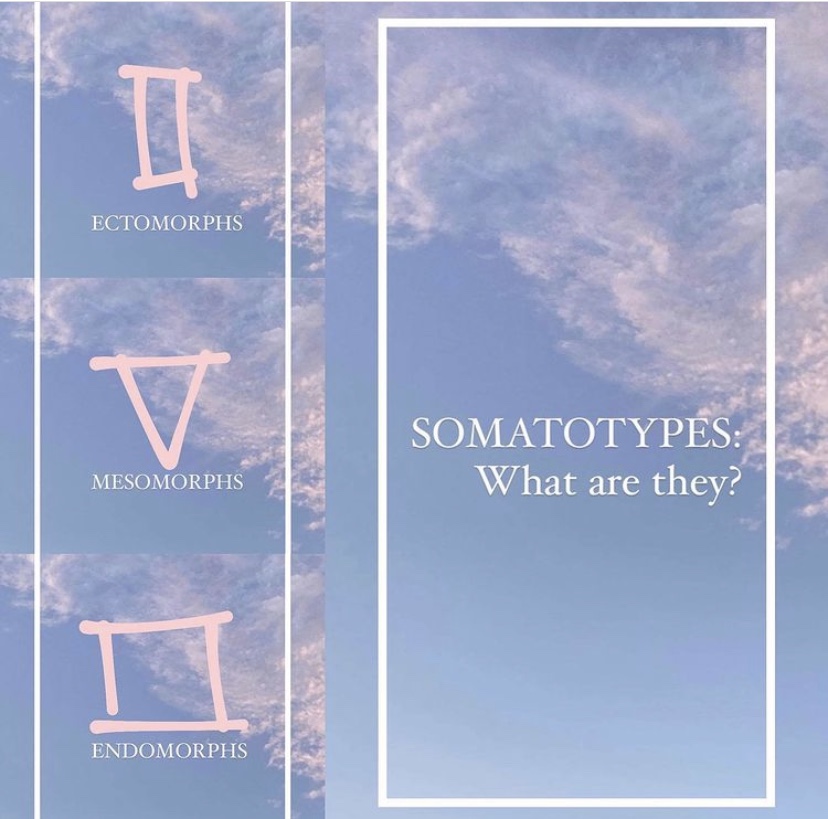
SOMATOTYPES: What are they?

It’s more than your rectangle, triangle and square body types let me tell ya!

For years I have read that somatotypes are a myth and do not play a key role in training & nutrition. I’m going to briefly explain why it’s not a complete myth.

Somatotype is a taxonomy developed in the 1940’s by American Psychologist, William Sheldon. He categorised human physique into three fundamental elements:

1. Ectomorph

2. Mesomorph

3. Endomorph

The names were based off the three germ layers of embryonic development: the ectoderm (outer layer), endoderm (inner layer) & mesoderm (in-between layer).

Embryology, in relation to somatotypes, provides us with the physiological understanding of what organs were dominant when we were forming as an organism (us as human beings!)- starting from the very minute we were conceived to the minute we left the womb.

Somatotypes were developed in the 1940’s by American Psychologist, William Sheldon. He categorised human physique into three primary classifications: ‘ectomorph’, ‘mesomorph’ and ‘endomorph’. These were named after the three germ layers of embryonic development: the ectoderm (outer layer), endoderm (inner layer) and mesoderm (in-between layer).

Embryology, with regards to Somatotypes, provides us with the physiological understanding of what organs were dominant in the formation of us as a human being – from the very minute we were conceived to the minute we left our mothers womb.

So let’s get to know each category better.

ECTOMORPHS

The ectoderm is responsible for the development of the nervous system (the brain, spinal cord and other nervous tissue), along with the outer epithelium of our body which makes up our skin, hair and nails. With all the attention on our nervous system, this means that someone of this somatotype is generally restless, usually on high alert or sensitive to sounds or stress.

As ectomorphs are neurologically overactive, less energy is placed on the rest of the body resulting in a naturally lean appearance. They struggle to put on weight and muscle due to their high metabolic rate. When it comes to their nutrition, carbs are their best fuel source.

They respond well to short intense workouts that focus on compound movements, making them good endurance athletes.

Because they are often overactive mentally, mindful exercises such as Yoga, Pilates or mediation can be great to relieve stress and are a great form of resistance training for the ectomorph.

MESOMORPHS

Cardiac & skeletal muscles form from the mesodermal layer as well as smooth muscles, blood vessels, connective tissues, the kidneys, heart, & the adrenal cortex. These are the building blocks in a mesomorphs appearance making the individual appear toned with a more athletic, broader build.

The mesomorph gains muscle & fat much easier than our ectomorphs & distribute it more evenly.

As extra energy lies in the adrenal cortex for the mesomorph, it is known to contribute to a temperament that can be quite competitive, success-oriented and driven. They have the natural ability to organise & lead, yet can be very judgemental & hot headed.

Because of their persistency & energy, this somatotype is designed to move! Mesomorphs thrive in higher intensity workouts that last for short periods of time & typically enjoy exercises/sessions with functional movements. HIIT style workouts, like CrossFit, AMRAP and Tabata are perfect for this somatotype.

Having a higher protein diet is best for the mesomorph with less emphasis on carbs, which is the primary source of fuel for the dominant organ structures mentioned.

ENDOMORPHS

The endodermal layer contributes to the formation of the primitive gut, pharynx & the thyroid. The gut forms the bronchi, lungs and the digestive tube composing of the pancreas, liver thymus & prostate. With the focus being more on the gut, endomorphs tend to have a more efficient yet slower metabolism.

The endomorph can get more from what they eat as well as keeping those nutrient reserves in times of scarcity. Although this results in giving off the more sturdy & strong appearance, the endomorphs hold more body fat than most (not mistaking them for being obese).

These energy reserves make the endomorphs more tolerant to chronic stress & because of this, this somatotype can take a lot of training load before overtraining.

The endomorph has the highest amount of fast twitch muscle fibres which contributes to their large amount of strength. They find it hard to build muscle mass because excess body fat triggers the release of the hormone oestrogen. With the increased levels of oestrogen comes a decrease in testosterone, the hormone that promotes muscle growth.

The endomorph responds extremely well to a diet with healthy fats & carbs, as well as protein rich foods, fruits & veggies.

Weight training is a great form of exercise for this body type however cardio is useful in burning calories and helps create a calorie deficit (using more calories than they are consuming to lose excess body fat). High intensity interval training is preferred as it increases muscular and cardiovascular endurance. A minimum of three days a week of HIIT training with consistent 30-60 minute steady state training are well rounded exercises for this body type.

The Conclusion

Although most people appear to be obviously unique to one of these characteristics, no one exists within purely one somatotype. This is mostly determined through lifestyle factors where each somatotype can alter their fat and muscle mass through diet & exercise. Basic bone structure however, will remain fixed.

You are born with an inherited body type based on bone structure & body composition. Understanding what body type you are on a more cellular level can be detrimental to your training & nutrition as it provides guidance in knowing how your body can best function due to certain foods or exercise (how it is used for fuel & energy).

IT’S A STATE OF MIND: Mental Wellbeing

“You’re in charge of your mind. You can help it grow by using it in the right way.” – Carol Dweck

You may have remembered I briefly mentioned Carol Dweck in my post, The Importance of Balance, and her study on mindsets within students. The study basically shows that it is inevitable that something inconvenient is going to happen in your life but it’s how you react to it that changes the situation itself.

You’re not always going to be happy and it’s important to note that with any time of depression, you remember that there are more reasons to be happy than sad. And 99.9% of the time, you may find that the positives far outweigh the negatives. Searching for the good in the “bad” will prevent you from dwelling on the issue for longer than is needed.

Something that has helped me is to practice gratitude daily. Every morning I just note down in my journal three things that I am grateful for and when I do that, I think about those things that I’ve written down for the whole day to come. When I remember the things I’m grateful for, it helps me put things into another perspective. For example if I have written that I am grateful for my partner Michael and if we have a slight argument I remember why I’m grateful for him and it helps me to then solve the issue we are having. 

You can practice gratitude at any point in the day, but personally I like to reflect on it in the morning because it truly helps me a lot throughout the day. 

It helps particularly when I feel like I’m comparing my life to others or like I’m not flowing through life like everyone else or if I speak about myself negatively. I remember I’m just grateful to be living the life I’m living. 

If journaling is not your thing, try finding other creative outlets. Some other tools that can be helpful are:

  • Exercise
  • Getting out into nature
  • Reading 
  • Dancing when no ones home
  • Going for a drive and blasting your favourite tunes, singing at the top of your lungs
  • Calling a friend

The list goes on! Just have a play around with a few things and find what works for you. 

I remember stumbling across this post on Pinterest and it said – “Everything in life starts with your mindset first and your actions second. Your actions follow your thoughts, beliefs and ideas. To make a shift, to free your energy: start with getting your mind right, and then, take action” – and honestly, I haven’t looked back. 

What I have taken away from this is that we must do the things we thought we couldn’t do. What seems normal to me now, was once very foreign to me, and I need to continue challenging myself and testing my limits in order to achieve better. 

When you’re in a good headspace, it’s naturally easier to react to situations in a better way because you have control over your emotions. 

One thing I find helpful is that whenever I notice myself having unhealthy thought patterns, I try to bring my attention to it by acknowledging that I am not feeling okay and try to understand why I am feeling that way, whether it be towards myself, another person or a certain situation. 

I then try to figure out ways on how to work on myself or what I need to say to that person or do in that situation. I know that when I confront the issue, I am going to feel better. If I don’t, then I will just sit, dwell and think about it. Ultimately, by not confronting issues and problems head on I just end up feeling anxious, possibly resulting in resentment. 

Sometimes it’s as simple as removing yourself from the environment and having a change of scenery. You could be changing and growing apart from the people closest to you and it may be best to take the leap and surround yourself around like minded people. It could be working in an environment that doesn’t align with your values and finding something that does. I’ve recently done this and it’s taken a bit of time for me to figure it out but trust me, when you get there you’ll be much better for it. 

Dwelling on the negatives only fuels your unhappiness. Acknowledge your feelings, understand your feelings and most importantly, feel your feelings. There is nothing “weak” with being emotionally mature as long as these emotions are dealt with in a healthy way. 

If you can, seek professional help. Talk to your doctor about how you’re feeling. Have them refer you to a professional to discuss it further. 

Recognising the thoughts you have and the feelings you have is just the first step and I’m proud of you for doing so. 

Remember to take care of yourself first x

LIFE’S TOO SHORT: Take Your Time & Stop Comparing

“The slow rush. Let’s take our time & live to be present. Live for the people in our lives. For future memories. For past mistakes. Live to outgrow ourselves & to help others grow. To explore. To create. To celebrate. A life is to be lived. To be cherished. To be changed. To be nurtured. Not to merely exist. Good things take time & when we slow down, we allow inner peace, clarity & happiness to enter our lives.”

If 2020 has taught us anything it’s to be present & grateful for the people and things we already have in our lives! For many the cons have outweighed the pros,but without just a little bit of struggle, we wouldn’t be able to grow. 

I’ve taken a little bit of a break from writing to focus on uni and to figure a few things out. I created this blog to share my approach to life because I think it’s important that we don’t take it so seriously. Despite this, more recently I have been feeling a little deflated. 

It may be because I take on too much at once (bloody Geminis), or it may be because I just put so much pressure on myself to have it all figured out that it stops me from being present and takes over my thought process. 

I’m 23 and I have been working in a full-time job since I was 18 because that’s just what I thought “you should be doing”. I look at all my friends who have been working in casual/part-time jobs. They have all had so much time to focus on their uni, travelling and building a memorable life that I felt like I had just wasted mine, when really that is not the case. Of course it’s different for everyone but I feel like I have just been working the wrong way. 

I found that I have been comparing my life with those that I grew up with and when you compare a part of yourself to someone else, it is generally a sign that there is an aspect of your life that you are not completely satisfied with. Comparison truly is the thief of joy so try and bring your awareness to those thought patterns and change something about it then tell yourself something positive to follow it. 

When I do get stuck in that thought pattern, I like to remind myself that the only person I should be comparing myself to is my past self. My yesterday self. 

When you compare yourself to others, you get nowhere and life can feel like you’re competing with others, not cooperating with others. Lately I have been thinking a lot about the life I am living and if my actions now are affecting the future I want for myself.

At the beginning of the year, I was happy but not satisfied with my day to day. I left my old firm for a new firm to see if all I needed was a change of environment and found that within four months of being in my new job, I was already applying and looking for new jobs then Coronavirus hit. Many people lost their jobs and had been affected in more ways than I can imagine by this virus and I felt like now was probably not a good time for me to quit my job. So I stayed. 

I put a lot of pressure on myself on trying to figure out what I should be doing with my life when really the whole time the question I should be asking myself is “what am I interested in?”, “what am I good at?” and “how can I make this a career?”. It’s so easy to focus on the deficits that we look past our progression. 

Of course stress is not ideal but it can be good for you. Good for you as in it helps you grow and become more resilient. You can manage it and choose what you stress about. So overthinking and stressing over a situation that YOU CAN control is not something you should be doing. It’s about bringing your awareness to your thought process and quickly catching the thought to stop it from progressing into something bigger than it needs to be.

Time went on and luckily for us Queenslanders COVID stayed away for the most part. I was constantly complaining about how unhappy I was with my job to the people closest to me but I realised I was doing nothing about it.. I was complaining so much that it literally affected almost every other aspect of my life. My health. My relationships. My mind. Nothing good ever comes out complaining, but by doing. 

With a little bit of tough love, some courage and a brand new opportunity, I finally resigned. Although I have no idea what to do for an income, I am moving onto a new venture and with all the doubt and worry that’s come into play, I will make it work. I don’t know a better way of wording this but I work best when I am under pressure and I am excited to go back to basics and try really hard for the things I want. 

I think that is one thing I have learnt more recently too. It is so easy for us to now go out and get the things we want in an instant, that most of the time we aren’t truly working hard for the things we want. 

And if I fail, at least I can say I’ve tried. 

I’m working hard now on my future self. 

Keep positive friends & look at tough situations as a form of growth & being. 

Nik x